Just mention the word SHARK and the majority of the planet’s human population will experience a frisson of inbred, subliminal fear. As terrestrial mammals we humans are both fascinated and repelled by sinister giant fishes that reputedly attack their prey with mindless omnivorous ferocity. However, the destinies of humans and sharks are so intertwined that we must endeavor to understand sharks and the roles they—and we—play in the Great Chain of Being that governs all that happens on and in the oceans we share.
Is a shark actually a fish? Yes: all other fishes have bony skeletons and belong to the class known as Osteichthyes, whereas sharks are vertebrate animals with a cartilaginous skeleton and belong to the class Chondrichthyes. Some ichthyologists have argued that sharks are more closely related to mammals than to the bony fishes. So, while it can be argued that sharks are not exactly fishes, the commonly accepted scientific view is that sharks are cartilaginous fishes.
How many species of sharks are there? To date marine biologists have identified some 440 species of sharks—but it is important to note that sharks are capable of hybridization—that is, the interbreeding of two related but genetically distinct species, with the resulting offspring being capable of reproduction. Ultimately some hybrid offspring may be recognized as distinct species.
All sharks have teeth, but the teeth are not fixed to the gums: rather, the teeth are attached to thick membranes inside the jaws. The mouth of a shark is under slung, and well behind the shark’s snout, but the thick membranes act as hinges, permitting the teeth to be thrust forward and protrude outside the mouth to bite and grasp more deeply. Sharks today range in size from the whale shark, a harmless giant that feeds almost entirely on plankton, and grows as large as 18 meters, to the dwarf lantern shark that grows no longer than 20 centimetres —small enough to fit easily inside a human’s palm.
Despite mankind’s primeval fear of sharks, sharks have been exploited for centuries. Every year multiple millions of sharks are caught solely for their fins and tails, highly prized in Chinese cuisine as the ingredients for “shark fin soup”. The bodies of these sharks, once their fins and tails have been cut off, may be processed into oils or fish meal—or in many instances—thrown back into the seas. If you have ever enjoyed the “fish and chips” so popular in the British Isles more likely than not, the white meat of the fried fish came from the spiny dogfish, a small shark whose populations around the British Isles have been greatly depleted by overfishing. (The gourmand adventurous enough to inquire into the origin of the fish would likely have been told that the fish was “huss” or “rock salmon”.) Italians consume millions of pounds of shark meat annually in the form of palumbo (smooth dogfish) and smeriglio (porbeagle). Steaks cut from the thresher shark are often found In upscale seafood markets in the United States.
Sharks and humans are apex predators. Small fishes and animals are eaten by larger fishes and animals, and so on up the food chain. When the numbers of smaller fishes and animals are reduced, the apex predators are affected. Sharks are early indicators of the health of the oceans. When the populations of smaller prey fishes are over-exploited, or die in large numbers due to pollution by such mechanisms as agricultural runoff that produces algae blooms which literally suck all the oxygen from the water, there is less prey for the larger fishes. Overall, shark populations have diminished, with some of the smaller species facing extinction. Fortunately, although they remain very vulnerable, the planet’s oceans are still healthy enough to support large populations of the larger sharks. Incidentally, incidents wherein sharks are reported to have attacked humans are relatively rare. The Florida Program for Shark Research at the University of Florida’s Museum of Natural History in Gainesville, Florida maintains the International Shark Attack File. The Yearly Worldwide Shark Attack Summary for 2018 reflected 130 incidents of alleged “shark-human interaction”. Sixty-six incidents were confirmed as “unprovoked shark attacks” on humans, while 34 incidents were confirmed as “provoked attacks”. Nine shark attacks on boats were confirmed, and other reported incidents were not confirmed or rated as “doubtful” (one attack occurred in a public aquarium!). Five attacks resulted in human deaths. The United States had the largest number of unprovoked shark attacks (32, with one fatality) and two unprovoked attacks were confirmed in South Africa, but with no fatality.
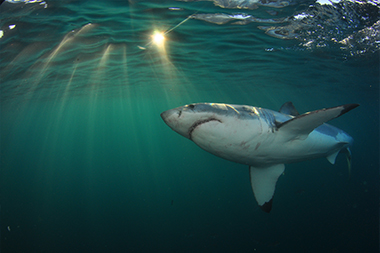
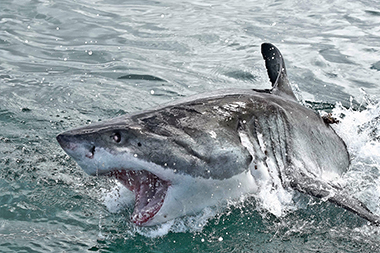
The shark species that most likely attracts the most interest from humans is the great white shark (carcharodon carcharias) as popularized in the series of Jaws movies. The great white may grow as long as seven meters, but an ancestor, carcharodon megalodon, grew much larger. The Hall of Fossil Fishes at the American Museum of Natural History in New York City houses a plaster reconstruction of the jaws of megalodon based upon the size of teeth found in the fossil record. The reconstruction, which is eight feet high, measures nine feet across the jaws, with the largest teeth some six inches in height, was based on the tooth-jaw proportions of modern white sharks, and is probably one third larger than an actual megalodon. Nevertheless, the reconstruction makes for a frightening tableau in a popular photograph that depicts six men standing inside the jaws. Truly, megalodon reigned supreme as the savage sovereign of the seas some 25 million years ago!
While found in all the planet’s oceans, the great white is migratory and rarely seen. However, there is one place where great white sharks may almost certainly be viewed, and that is in the waters of Gansbaai (bay of geese), a fishing town in the Western Cape Province of South Africa. Viewing great white sharks from shark-proof steel cages lowered into the water from large boats began in 1995, and attracts large numbers of tourists to South Africa, numbers second only to tourists visiting the Kruger Park. “Cage diving” for great white sharks is not for everyone, but the rewards of viewing these great descendants of megalodon, whose destinies as apex predators are inexorably intertwined with humans are impossible to quantify.